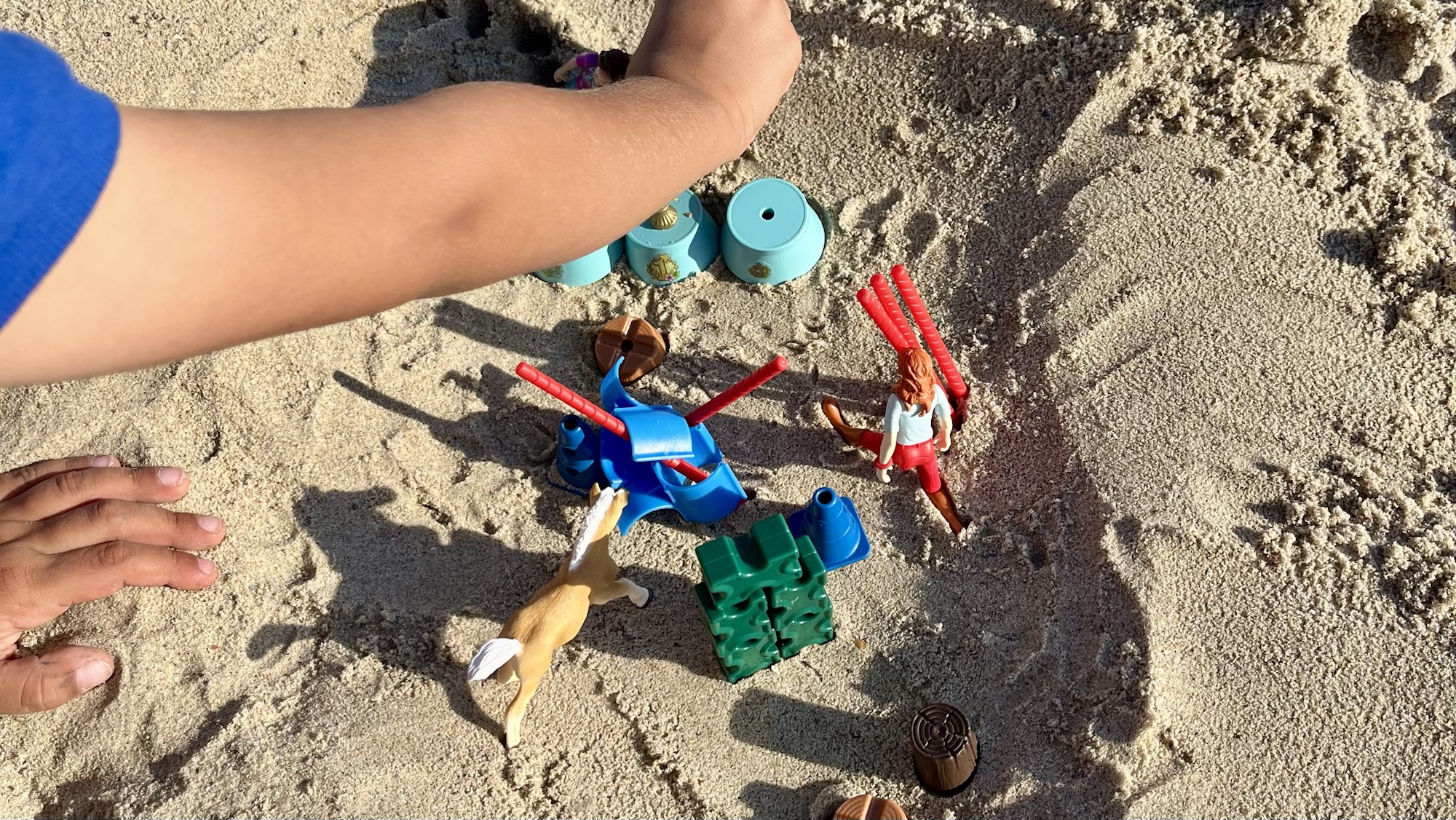
There are days when it feels like my children need me for absolutely everything.
“Mom, can you help me?”
“Mom, watch this!”
“Mom, I’m hungry.”
“Mom, he took my toy.”
“Mom, what should I do?”
And while I love being their mom, I don’t want to spend every waking hour directing their play, solving every little problem, or coming up with the next activity.
I want my boys to know how to play.
Not because I want them out of my way all day.
Not because I don’t enjoy spending time with them.
And certainly not because I think children should be expected to entertain themselves constantly.
I want them to experience the freedom that comes from being able to look around, find something interesting, and think, “I can do this myself.”
Learning how to encourage independent play has become an important part of creating a calmer rhythm in our home.
It gives my children space to explore their own interests, and it gives me permission to be their mom without feeling like I have to be their full-time cruise director.
And honestly, we could all use a little less cruise director energy around here. 😂
What Independent Play Actually Means
Independent play doesn’t necessarily mean your child disappears into a room for two hours and plays quietly while you clean the entire house.
Would that be lovely sometimes?
Absolutely.
Is that realistic every day?
Probably not.
Independent play simply means giving your child opportunities to play, explore, create, and make decisions without an adult directing every part of the experience.
Sometimes that might mean playing with LEGO on the floor while I’m nearby folding laundry.
Sometimes it’s building a fort in the living room.
Sometimes it’s looking through books, drawing, playing with toy animals, or creating an elaborate imaginary world out of whatever happens to be available.
And sometimes independent play lasts five minutes.
That’s okay.
The goal isn’t to produce a child who never needs Mom.
The goal is to gradually help our children become comfortable with their own ideas.
Why Independent Play Matters in Our Home
One of the biggest reasons I value independent play is that it changes the rhythm of our days.
When children expect Mom to provide the activity every time they’re bored, every quiet moment can become another request.
But when they have some experience playing independently, boredom doesn’t necessarily have to become a problem.
It can become a beginning.
They might discover the box of LEGO they’ve forgotten about.
They might start building a fort.
They might take their toy cars outside.
They might create a game that makes absolutely no sense to me but keeps them happily occupied for half an hour.
And that matters.
I want our home to have room for both togetherness and independence.
I want my children to know that I’m available when they need me.
But I also want them to know that they are capable of doing things without me.
The Benefits of Independent Play
Independent play offers children something that structured activities can’t always provide: ownership.
When an adult is leading an activity, there is usually a right way to do it.
When a child is playing independently, the possibilities are much wider.
It Encourages Creativity
When children aren’t being told what to do next, they have to come up with something themselves.
A pile of blocks becomes a castle.
A blanket becomes a tent.
A stick becomes a sword.
A few LEGO characters become the stars of a very serious adventure.
This kind of open-ended play gives children space to experiment and imagine.
It Builds Problem-Solving Skills
If I’m constantly stepping in to solve every little problem, my children don’t get as many opportunities to figure things out themselves.
Independent play creates those opportunities.
The tower falls down.
The car won’t fit.
The fort keeps collapsing.
The LEGO piece doesn’t seem to work.
Instead of immediately fixing everything, I can sometimes simply give them space to work it out.
That doesn’t mean refusing to help.
It means giving them a chance to try first.
It Helps Children Become Comfortable With Boredom
I don’t think boredom is something we need to eliminate from childhood.
In fact, I think a little boredom can be incredibly useful.
When there is always something planned, provided, or playing in the background, children don’t have as many opportunities to ask themselves what they actually want to do.
A little boredom can be the space where an idea appears.
And some of my boys’ best play has started with:
“Mom, I’m bored.”
My response isn’t always to give them an activity.
Sometimes it’s simply:
“I know. You can figure something out.”
And eventually, they usually do.
It Gives Mom a Little Breathing Room
This matters too.
We don’t have to feel guilty about admitting that we need a few quiet minutes.
Independent play gives me opportunities to make dinner, answer an email, fold laundry, drink a cup of coffee while it’s still warm, or simply sit down for five minutes.
Motherhood already asks a lot of us.
We don’t need to manufacture exhaustion by believing we have to be involved in every moment of our children’s play.
A calmer home includes space for Mom, too.
How to Encourage Independent Play
If your child is used to having an adult nearby or asking Mom what to do every few minutes, suddenly saying, “Go play by yourself!” probably isn’t going to work very well.
Independent play is something we can gradually encourage.
And thankfully, it doesn’t require a complicated system.
Start With Small Amounts of Time
You don’t need to aim for an hour.
Start with five or ten minutes.
Choose something your child enjoys and let them know you’ll be nearby.
You might say:
“I’m going to make lunch. You can build while I’m in the kitchen.”
Then let the play unfold.
Over time, those little pockets of independent play can naturally become longer.
The goal is progress, not a stopwatch.
Give Them Fewer, Better Choices
Sometimes children struggle to play because there are simply too many things available.
A room overflowing with toys can actually make it harder to decide what to do.
You don’t need to remove every toy from your home, but rotating or simplifying what’s available can help.
Instead of presenting twenty possibilities, you might leave out:
- LEGO or building blocks
- A few favorite vehicles
- Art supplies
- Dolls or action figures
- Books
- Puzzles
- A simple pretend-play setup
Fewer choices can make it easier to begin.
Choose Open-Ended Toys
Some toys have one obvious purpose.
Others can become almost anything.
Building toys, art supplies, figurines, dress-up clothes, play kitchens, toy animals, and simple vehicles can all give children plenty of room to create their own games.
This is one reason I’ve always loved toys that don’t do all the playing for the child.
The more the toy does, the less the child sometimes has to imagine.
Give them a box of LEGO, though?
Suddenly that box can become an entire world.
Let Them See You Doing Your Own Things
Independent play doesn’t always have to happen in a separate room.
Some of my favorite moments are when my boys are playing nearby while I’m doing something else.
I’m folding laundry.
They’re building.
I’m cooking.
They’re playing.
I’m cleaning up the kitchen.
They’re drawing at the table.
We’re all in the same general space, but we’re not doing the same thing.
I think that is an important distinction.
Being nearby doesn’t mean being constantly involved.
Children can learn that Mom has things to do, too.
And they can learn that being together doesn’t require constant interaction.
Resist the Urge to Entertain Immediately
This one can be hard.
A child says, “I’m bored,” and our instinct can be to solve it.
We suggest a game.
We find a craft.
We offer a snack.
We turn on a show.
We pull out a new toy.
But sometimes the kindest response is to leave a little space.
You can acknowledge their boredom without fixing it.
“I know. Being bored doesn’t feel very fun. I’m sure you’ll think of something.”
Then give them time.
The silence after that sentence may feel uncomfortable at first.
Let it.
Sometimes creativity needs a little quiet before it shows up.
Don’t Interrupt Good Play
If your child is happily playing independently, try not to interrupt just because you suddenly remember something you wanted to ask them.
This sounds obvious, but I’ve caught myself doing it.
They’re peacefully building something.
I’m walking past and think, Oh! I need to tell him about tomorrow.
No.
Unless it’s important, it can wait.
Let the play continue.
Those uninterrupted stretches are valuable.
Create Simple Rhythms
Children often respond well to predictable rhythms.
That doesn’t mean your entire day needs to run according to a color-coded schedule.
Please don’t add another thing to your list just because the internet told you to. 😂
A simple rhythm can be enough.
Maybe after breakfast there is some independent play.
Maybe there is a quiet period after lunch.
Maybe while Mom gets dinner started, the kids know they can play nearby.
When children know what generally happens next, they don’t have to ask quite so many questions.
And Mom doesn’t have to make quite so many decisions.
That alone can make a home feel calmer.
Let Them Play Imperfectly
This is perhaps the hardest one for us as adults.
We see the fort.
It’s lopsided.
We see the LEGO creation.
It doesn’t look anything like the picture.
We see the art project.
There is paint everywhere.
And we want to help.
But independent play means allowing children to own the process.
It doesn’t need to look good.
It doesn’t need to be productive.
It doesn’t need to make sense.
Play is allowed to be messy, strange, repetitive, and completely child-led.
Common Mistakes to Avoid
Learning how to encourage independent play doesn’t mean doing everything perfectly.
There are a few things I’ve found helpful to keep in mind.
Don’t Expect Too Much Too Quickly
If your child has always relied on you for entertainment, they may not suddenly become an independent player overnight.
Start small.
Be patient.
Build the habit gradually.
Don’t Use Independent Play as a Replacement for Connection
Children still need our attention.
They need cuddles, conversation, shared experiences, reading together, outdoor adventures, and time simply being with us.
Independent play isn’t about withdrawing from our children.
It’s about creating a healthy balance.
Connection and independence can exist together.
Don’t Turn Every Quiet Moment Into Productivity
This one is especially important for moms.
If your child finally settles into independent play, you don’t necessarily have to use those 30 minutes to clean the entire house.
Sometimes you can sit down.
Read something.
Have a cup of coffee.
Take a breath.
Rest.
A sane home isn’t one where every available minute is optimized.
Don’t Step In Too Quickly
If your child is struggling with something, pause before immediately fixing it.
Ask:
“Do you want help, or do you want to try again?”
Sometimes they’ll need you.
Sometimes they’ll surprise you.
Both are okay.
Don’t Compare Your Child to Someone Else’s
Some children naturally love independent play.
Others need more support.
Some can play alone for an hour.
Others are ready for ten minutes and then need connection again.
There is no prize for having the child who can play independently the longest.
We’re raising people, not productivity machines.
A Gentle Reminder for Mom
If you’re trying to learn how to encourage independent play because you’re exhausted from constantly being needed, I want you to know something:
You are allowed to want some space.
You can love being a mom deeply and still not want to play pretend for three straight hours.
You can enjoy your children and still need quiet.
You can be present without being constantly available for entertainment.
And you don’t have to feel guilty about that.
I think one of the most beautiful parts of motherhood is watching our children slowly become more capable.
At first, they need us to do everything.
Then they want to do it themselves.
Eventually, they start figuring things out without asking us first.
Those little moments can be easy to miss when we’re focused on everything that still needs our help.
But they’re worth noticing.
The child who used to say, “Mom, what should I do?” is suddenly building something on the floor.
The child who needed you beside him is happily creating a story by himself.
The child who was bored five minutes ago has disappeared into an imaginary world.
Those are small signs of growing independence.
And we don’t have to rush them.
Independent Play Doesn’t Have to Be Complicated
You don’t need a special playroom.
You don’t need expensive toys.
You don’t need elaborate activity bins.
You don’t need a Pinterest-perfect setup.
You simply need to create some space for your child to explore, and then give them the opportunity to use it.
Sometimes that looks like LEGO spread across the floor.
Sometimes it’s a pile of books.
Sometimes it’s drawing at the kitchen table.
Sometimes it’s playing outside with sticks, rocks, and whatever else they find.
And sometimes it’s a cardboard box.
Children are remarkably creative when we give them the chance.
Our job isn’t always to provide more.
Sometimes it’s simply to step back enough for them to discover what they can do on their own.
Final Thoughts
Learning how to encourage independent play has less to do with teaching our children to play alone and more to do with creating a home where they feel comfortable exploring, imagining, and figuring things out for themselves.
It’s about giving them opportunities without putting pressure on them.
It’s about allowing boredom without immediately solving it.
It’s about choosing toys that invite creativity.
It’s about creating simple rhythms instead of filling every minute.
And it’s about remembering that our children don’t need us to make every moment meaningful.
Sometimes they just need space.
Space to build.
Space to imagine.
Space to make a mess.
Space to be bored.
Space to figure something out.
And space to discover that they are capable of creating their own fun.
For me, that’s one small part of creating the kind of home I want for my family—a home that feels peaceful, intentional, and lived in.
A home where my boys know they are loved and connected to me, but also know that they are capable of doing things on their own.
And a home where Mom gets to breathe, too.
Shop the Independent Play Favorites
Looking for a few simple, open-ended toys to encourage independent play at home? I’ve gathered some of our favorite LEGO sets, building toys, pretend-play favorites, books, and screen-free activities below—simple things that give kids room to create and imagine while giving Mom a little breathing room, too. 🤍
A beautiful art supply set for kids
This beautiful wooden play kitchens
Some links may be affiliate links, which means I may earn a small commission at no additional cost to you.


